

America at 250: A Beacon for the AI Age — A Republican Warning
A 112,000-word volume titled America at 250: A Beacon for the AI Age is set to launch at Harvard’s Loeb House on May 1, 2026, timed with the nation’s 250th birthday. Its principal authors include former Massachusetts Governor Michael Dukakis and the CEO of the AI World Society, and its stated aim is to offer a vision of AI-shaped governance. From a Republican perspective, this is not neutral civic reflection; it’s a proposal that replaces a constitutional framework with technocratic design.
The book and the Boston Global Forum’s framing trade in familiar language—renewal, dignity, and democratic leadership—yet their programmatic moves matter. The conference itself declared that America’s role in the AI Age is “not only national power, but the capacity to design a trusted AI order that the world chooses to join — grounded in freedom, human dignity, accountability, and shared prosperity.” Those words sound noble, but they imply designers, certifiers, and an international order that supersedes national constitutions.
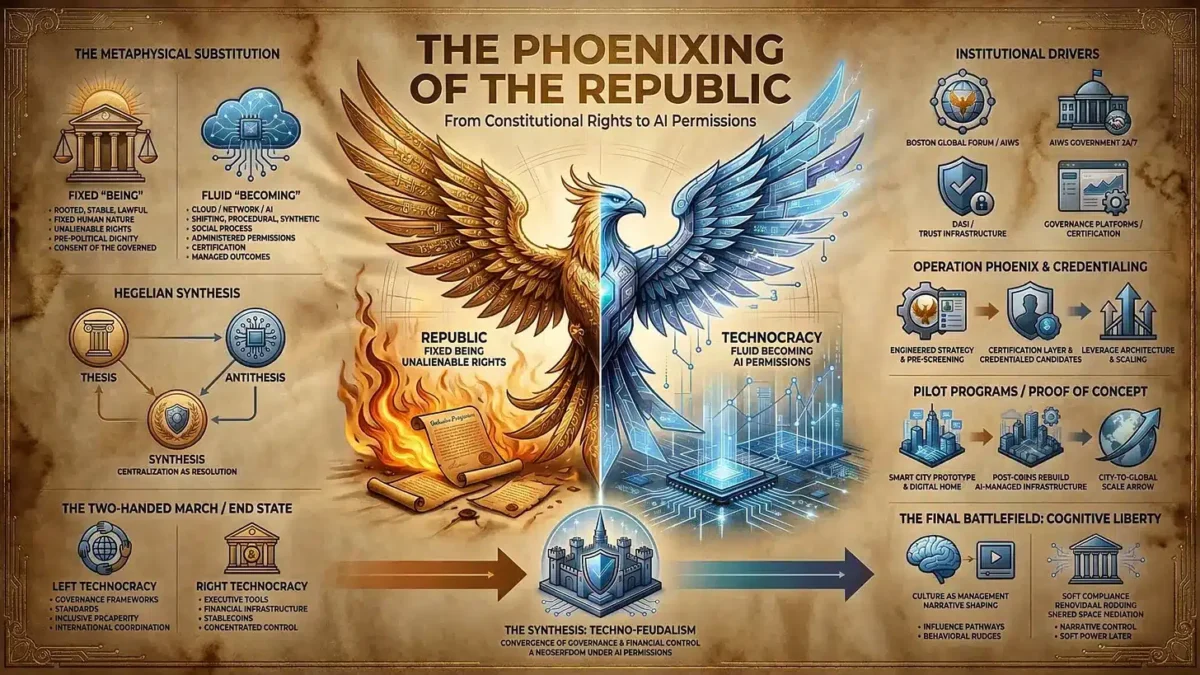
Technocracy’s first philosophical step is predictable: swap Being for Becoming so rights become certifications rather than pre-political protections. The Declaration’s metaphysical foundation—men are “endowed by their Creator with certain unalienable Rights” and “We hold these truths to be self-evident”—rests on a fixed human nature. Replace that premise and you replace the need for unalienable rights.
Practical proposals in the AIWS ecosystem are already visible: pilot “AIWS City” experiments, digital homes for personal data, blockchain validation, and a certification architecture called DASI. The program label “AIWS Government 24/7” promises continuous, AI-powered governance—an administrative apparatus that removes the friction Madison built into republican government by design.
The venue matters because prestige lends credibility. Convening a 112,000-word blueprint at Harvard’s Loeb House projects authority and normalizes technocratic redesign as tradition rather than departure. The phoenix symbolism is instructive here: “The phoenix does not restore what was. It replaces it with something new, wearing its ashes.”
Electoral projects fit the same pattern. Operation Phoenix and its partners run candidates through certification systems and PAC structures that openly promise engineered outcomes. The United Independents PAC’s own slogan, “We Engineer Wins,” frames elections as systems design exercises rather than citizen-driven representation.
That certification model is the core threat: credentialed managers, pre-aligned candidates, and governance frameworks decided off-ballot replace representative consent with pre-approved compliance. The Better Governance Institute and allied funders create the criteria; voters only choose among what those criteria allow. That is power concentrated by process, not by popular sovereignty.
This dialectic plays out across ideological lines. Movements from Game B to Dark Enlightenment converge operationally on the same outcome: techno-feudal governance layered under a managed democratic surface. Left and right instruments can be co-opted—one builds the cage, the other sells the key—while the citizen’s authority erodes.
Culture is also a front. The Film Park and “cultural diplomacy” pillars propose making storytelling and sacred places components of governance. When institutions begin to produce the moral language of a people, cognitive liberty—our right to think and dissent—becomes the final battlefield.
Our constitutional order rests on metaphysical claims that precede politics: a moral ontology grounding rights, derived from human nature and discoverable by ordinary reason. The framers did not treat rights as negotiable outputs of process; they treated rights as faculties of the person. Replacing that foundation with process-centered governance undermines the whole republican project.
Benjamin Franklin’s famous line captures the risk: “A republic, if you can keep it.” Keeping it means citizens who understand why the structure exists, not managers who redesign it in the name of efficiency or renewal. A republic is preserved by fidelity to fixed principles, not by perpetual reinvention.
America at 250, convened in elite venues and backed by transnational design blueprints, reads less like a birthday tribute and more like a match. The question for voters is whether they want rights recognized as pre-political truths or recast as services to be certified by an AI-enabled administration. The choice determines whether the Republic is kept or phoenixed away.