

Frank Lloyd Wright’s Prairie Style: A Close Look
Wright’s Prairie Style pushed back against Victorian fuss and imported ideas, aiming for an architecture that felt native to the American Midwest. It stressed horizontality, sheltering roofs, and rooms that flowed into each other, all meant to match the flat prairie landscape. The Frank Lloyd Wright Trust has led research and preservation efforts that keep these concepts in public view.
The style grew out of a desire to create an authentic American architecture rather than copy European models. Wright and his contemporaries pursued forms that emphasized line, proportion, and site-specific design. That made each building a dialogue with its setting rather than an isolated object.
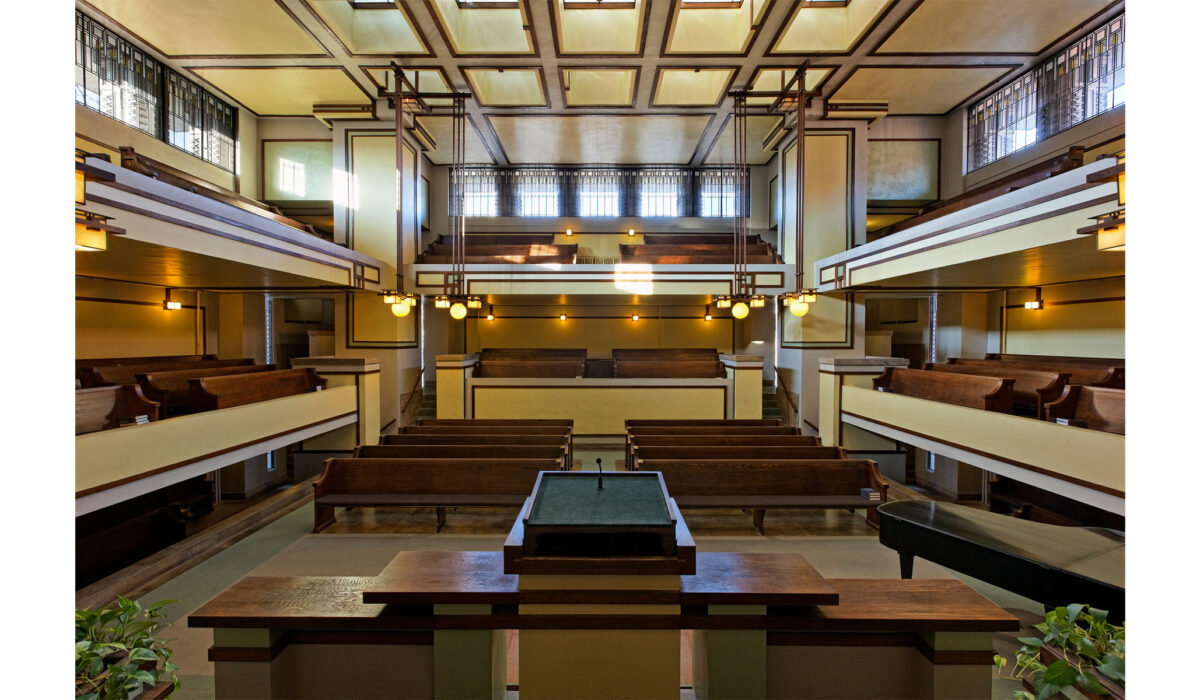
Key visual cues are low, cantilevered roofs, wide overhangs, and bands of windows that stretch horizontally. These elements reduce vertical emphasis and create a grounded, sheltering feel. Inside, open plans break down rigid room separations to encourage family life and movement.
Materials were chosen for texture and honesty: brick, stone, wood, and natural finishes that age gracefully. Wright favored stains and natural pigments over ornate surface decoration. The idea was to let materials express structure and to keep ornament integral to the architecture.
Integration with the site is central to the Prairie approach, so a building could follow the slope, align with views, or frame sunlight. Landscape and house work as partners instead of rivals. This approach shaped not just form but how people used outdoor and indoor spaces.
Wright’s plans often include signature motifs—geometric patterns in windows and screens, repeated horizontal lines, and open hearths as social anchors. These features create a visual language that ties rooms together. They also helped builders replicate the style while allowing for customization.
The Frank Lloyd Wright Trust has become a primary steward of that language, cataloging drawings, restoring houses, and offering academic resources. Their work keeps living examples available for study and public tours. It also provides conservation strategies that balance historical accuracy with modern building needs.
Preservation has practical challenges: old materials fail, codes change, and original systems are inefficient by today’s standards. The Trust documents original conditions and develops sympathetic updates that keep character while adding safety and comfort. That work requires both historical expertise and pragmatic problem solving.
Prairie Style influenced midcentury and contemporary architects who adopted open plans and site awareness without copying Wright’s exact motifs. Elements like horizontal emphasis and indoor-outdoor continuity reemerged in different materials and scales. The legacy lies more in principles than in stylistic mimicry.
Misconceptions persist: Prairie houses are not always sprawling mansions, nor are they purely decorative experiments. Many were middle-class homes designed for modest budgets and efficient living. Their innovations often solved social needs, like flexible living spaces and natural ventilation, rather than serving only aesthetic goals.
Studying Wright’s Prairie Style offers lessons in proportion, restraint, and environmental fit that remain useful today. Designers can borrow the commitment to site, honest materials, and plans that prioritize human life over showy form. Those practical lessons help architecture respond to climate, community, and cost concerns.
Visiting restored Prairie houses or reviewing the Trust’s archives reveals how detail decisions add up to a coherent whole. You start to see how window placement controls light, how low roofs shape perception, and how built-in furniture tightens spatial logic. Those specifics illuminate why the style still matters to architects and homeowners alike.
Looking ahead, the ongoing stewardship by institutions like the Frank Lloyd Wright Trust will determine how future generations read and reuse Prairie ideas. Adaptive reuse, careful restoration, and critical study keep the conversation alive without turning the past into a museum replica. This attention keeps the style relevant while allowing it to evolve.