

Wall Street’s Push to Put the $126 Trillion Equity Market on Blockchains
The blockchain isn’t replacing Wall Street’s plumbing. It’s being plumbed into Wall Street. The token is not an independent record of ownership — it is a downstream artifact of the DTC’s ledger. If the DTC revokes or freezes the underlying entry, the token is worthless. In one sense, it is a simulacra but controlled by another entity. ⁃ Patrick Wood, Editor.
The biggest exchange operators are now teaming with crypto platforms to test tokenized shares, creating both rivalry and partnership as they chase a market that’s valued at about $126 trillion. These moves are concentrated on making traditional stocks tradable on blockchain rails while keeping existing legal and governance structures intact. The result is an industry-wide scramble to build an “everything” marketplace where many asset types coexist on shared infrastructure.
Nasdaq is building a framework to let listed companies issue blockchain versions of their shares while preserving traditional ownership rights and governance, and it is working with Payward, the parent company of Kraken, to distribute those tokenized stocks globally. The offering could go live as soon as the first half of 2027. At the same time, Intercontinental Exchange invested in OKX at a $25 billion valuation and plans to launch tokenized stocks and crypto futures to reach OKX’s 120 million users.
The technology shift is pitched as more than a new product line; it’s a change in market structure. Blockchain proponents argue it enables continuous price discovery and around-the-clock trading, replacing separate systems with a unified, always-on marketplace. That promise is what drives incumbents to experiment with tokenized securities despite the complexity.
Antoine Scalia, founder and CEO of Cryptio, framed the trend as a long-expected merger of worlds. “For a very long time, it was just crypto people pushing the narrative that traditional finance and crypto would merge,” Scalia said. “Now we see the major exchanges moving.”
“That’s a realization that eventually all assets will settle on blockchain rails,” he added. The industry got an extra nudge from a January SEC Staff Statement on Tokenized Securities that clarified tokenized equities can carry the same legal weight as paper counterparts, giving incumbents legal cover to enter this market.
The competitive question is simple: which platforms will dominate — legacy exchanges like Nasdaq and ICE or crypto-native venues like Coinbase and Kraken? Yet competition doesn’t erase cooperation, because traditional exchanges want access to crypto traders while crypto platforms need distribution and credibility from established infrastructure. That interdependence is reshaping deals and product road maps across both sectors.
“Distribution works both ways,” Scalia said. “Traditional exchanges want exposure to the crypto trading population, and there’s huge demand from crypto users to trade other types of assets. At the same time, crypto-native firms benefit from the reach of these traditional players to bring more people into crypto markets.”
Scalia called the relationship “a very interesting dynamic with frictions and complementarity.” “And it will be interesting to see how it plays out,” he added, underlining that the long-term winner is still unclear but the incentives to cooperate are real.
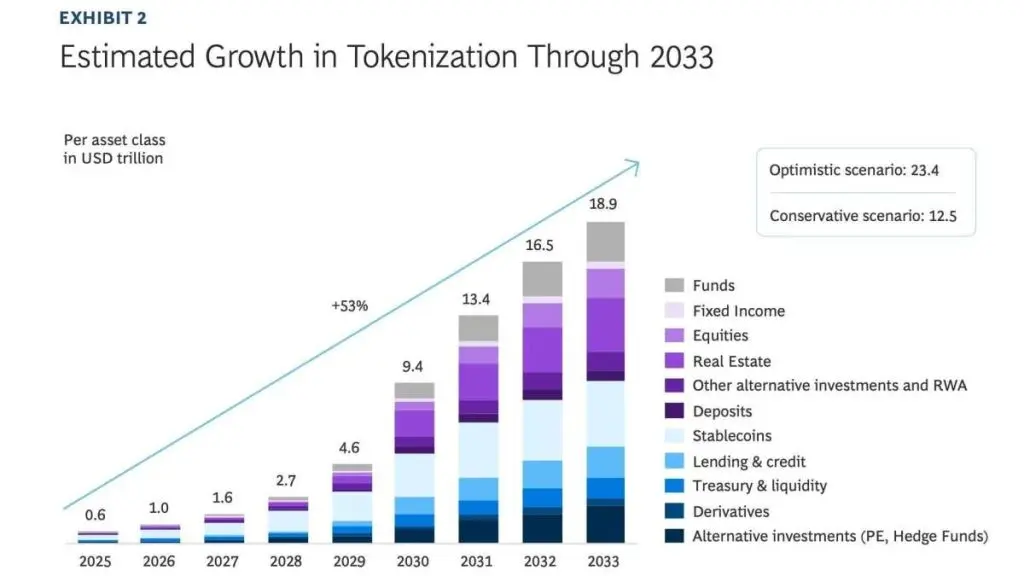
Today, tokenized equities are a small corner of markets — roughly $1 billion — but the growth prospects are large. A joint report by Boston Consulting Group and Ripple modeled tokenized assets growing 53% a year and reaching $18.9 trillion across asset classes by 2033 under a base case scenario.
On-chain stock markets have already expanded quickly: the market for tokenized stocks has more than tripled since mid-2025 as a range of issuers and trading venues introduced token versions of equities. Early adopters say tokenization can improve liquidity, enable continuous trading and open new DeFi use cases like lending and borrowing using tokenized shares as collateral.
Yuki Yuminaga, founder of Tenbin Labs, highlighted the trading and liquidity upside while flagging current limits. He pointed out that blockchain-based assets can trade around the clock and thus enable continuous price discovery. “Tokenized equities have struggled with liquidity because traditional markets and onchain markets are separate,” Yuminaga said. “If Nasdaq connects those two pools of liquidity, that could change the equation.”