

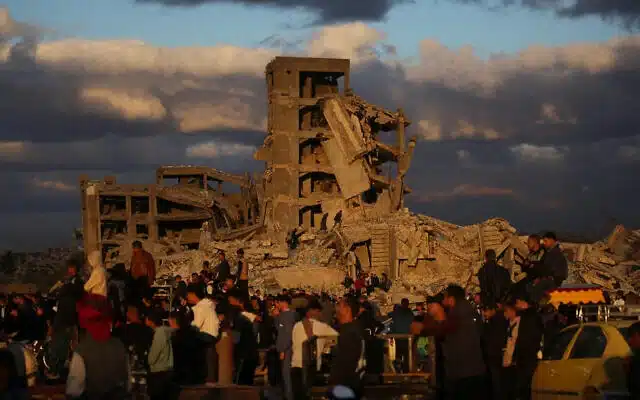
Technocracy’s Gaza Prototype: Who Really Rebuilds and Who Benefits
There is a principle at the core of Technocracy that its architects described at Columbia University in the 1930s and researchers have tracked ever since: the replacement of political governance by scientific and technical management, wielded by a self-selected expert elite. That idea is now visible in plans for Gaza’s reconstruction and it deserves blunt scrutiny. The rhetoric of humanitarian rebuilding often masks a different agenda.
The 32-slide “Project Sunrise” blueprint, drafted by Jared Kushner and Steve Witkoff and evaluated by the Trump administration in late 2025, proposes the “voluntary” relocation of Gaza’s 2.3 million residents, wholesale demolition, and the construction of six to eight “AI-enhanced smart cities” on cleared land. The model includes biometric checkpoints, tightly controlled zone access, a manufacturing hub, and a port economy. That reads less like relief and more like a territorial redesign authored by a private management class.
The monetary plan reveals how power is baked into the architecture. A privately governed reconstruction body called the “Board of Peace” demands $1 billion per permanent seat, names Trump as perpetual chair with veto power, and is actively exploring a dollar-backed stablecoin for Gaza’s postwar economy. The proposed coin, labeled “USD1” and associated with “World Liberty Financial,” would be smart-contract-governed and digitally monitored, embedding financial control at the transaction level.
Steve Witkoff plays multiple roles in the same ecosystem: co-founder of the firm behind “USD1,” an official envoy shaping diplomatic and political outcomes, and the Board’s operational lead. That is not an incidental conflict, it is structural. When the same players design the political framework and own the financial rails, the reconstruction becomes a vertically integrated project with citizens as consumers, not stakeholders.
Programmable money needs a programmable identity system to function. In a territory stripped of functioning banks, correspondent relationships, and cash infrastructure, a private, identity-linked digital dollar is effectively the only monetary option. That absence of alternatives is classic Technocratic control: not by outlawing choices, but by eliminating any feasible substitute.
Surveillance and infrastructure companies are already named in the operational blueprint: “Palantir Technologies” for biometric identification platforms, “Oracle” for cloud infrastructure, and Starlink for connectivity. These firms are integrated into the coordination center overseeing reconstruction, and residents entering proposed zones would pass biometric checkpoints tied to access privileges. One correspondent called the scheme “A laboratory for government surveillance,” and the phrase fits the design.
Jared Kushner’s headline $70 billion pitch conjures 180 skyscrapers, data centers, advanced manufacturing, and tokenized real estate investment vehicles. Investors would buy “WLF asset tokens” representing construction revenue, settled in “USD1,” and audited by private entities like BitGo Bank & Trust under proposed legal frameworks. The economic upside is structured for global capital, not for displaced Gazans.
The Board of Peace’s roster reads like a finance-and-diplomacy club: Kushner, Witkoff, UAE sovereign wealth via Sheikh Tahnoon with a near-majority stake in WLF, Tony Blair, and nation-states buying $1 billion seats. Meanwhile, the managed population—2.3 million displaced Gazans—has no representation, no vote, and no institutional veto. That concentration of decision-making power is the essence of the Technocratic model.
Political framing helps shield the architecture from critiques. Trump was designated “Prince of Peace” by the Israel Heritage Foundation before the Board existed by name, and the Board’s charter invokes peace while lacking accountability mechanisms. Critics who point to conflicts or loss of local autonomy are painted as opposing recovery; the benevolent language acts as political armor.
What is unprecedented is the experiment’s scope: simultaneous control over money (“USD1”), investment (WLF tokens), governance (Board of Peace), surveillance (Palantir/Oracle biometrics), connectivity (Starlink), diplomacy, and physical design (“Project Sunrise”) inside a single bounded territory. Technocracy’s founders imagined technical management for energy grids; they likely did not expect the first full-scale deployment to be a densely populated Middle Eastern enclave reduced to 365 square kilometers of rubble.
Viewed this way, Gaza is not simply a reconstruction project. It looks like a prototype for a new governance model where private technical elites design societies, monetize infrastructure, and enforce order through embedded digital systems. That reality raises hard questions about sovereignty, consent, and who truly benefits when rebuilding is run like an investment play.