

The Invisible War on Real Food
Regulatory capture, tokenization, and synthetic biology are converging into a programmable food system. Most Americans won’t see it coming until their plate is empty. We need food to survive.
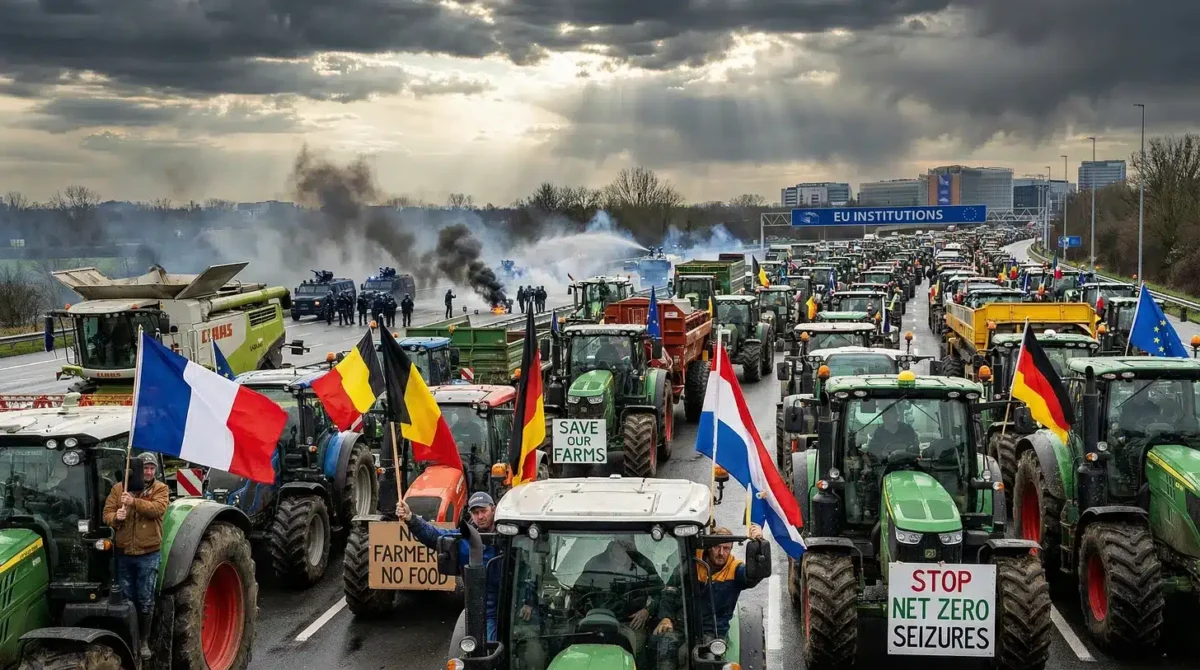
Europe is erupting in visible protest while the United States gets a quiet rollout through paperwork, procurement, and finance. Farmers hit the streets with tractors and headlines; here the squeeze happens via supply-chain rules and corporate mandates. The effect is the same: human decision-making about food gets outsourced to systems and protocols.
“Watch the scale—then ask why Americans rarely see this.”
The control stack is simple to name even if hard to resist: Control the metrics → control market access → replace real inputs → replace real food → tokenize enforcement → make it programmable. Each layer looks optional on its own, but stacked they change who decides what people eat.
When tractors block roads, shortages are obvious. When shelves stay full thanks to global imports, the squeeze can happen quietly for years. That difference buys time for systems architects to finish the infrastructure they want in place.
“These tractors are huge… you don’t want to mess with them.”
MRV—measurement, reporting, verification—turns food into data and then into collateral. Once inputs are auditable and verifiable, finance, insurance, and procurement routes can favor compliant suppliers and lock out others. That’s governance by market access, not by vote.
Walmart sets the metrics → suppliers measure → suppliers report → third parties verify → Walmart tracks compliance.
Substitution doesn’t announce itself as a ban. It sneaks in as ingredients and flavor-perfect substitutes produced in bioreactors. “You’ve already been eating it” becomes a defense when precision-fermented proteins show up in mainstream brands.
Perfect Day and similar companies make dairy-identical proteins using engineered microbes and sell them as ingredients to big brands. That business model is B2B: novelty products, supplier deals, normal shelf placement, and label confusion. Consumers see familiar products but the sourcing has shifted from soil and animals to fermentation vats and code.
Precision fermentation is not traditional fermentation. It manufactures molecules at industrial scale and installs them into foods like interchangeable parts. Marketing will call it kinder and greener while the sourcing story grows murkier.
Microbiome testing and nutrition personalization add another layer: your biology becomes a profile, food becomes a prescription, and compliance gets framed as health. Once “optimization” is the standard, dissent looks irresponsible. That’s how substitution gains moral cover.
Tokenization is the enforcement hinge. Digital tokens can carry embedded rules and smart contracts that settle transactions only when conditions are met. Aaron Day warned that “Tokenization is the gateway to total control.”
If compliance rules ride inside payment rails, enforcement needs software not police. That turns choice into a technical check at checkout: recommendations to requirements to “your payment won’t clear.” This is where the system becomes directly coercive without new laws.
Consolidation in genetics, processing, and distribution creates the squeeze that makes lab substitutes politically palatable. Low herd counts, tight packing capacity, and opaque middle layers can all be framed as justification for engineered replacements. When people feel scarcity, even radical fixes look reasonable.
Language and rebranding do heavy lifting: words like regenerative shift from soil resilience to carbon accounting and MRV compliance. The machinery keeps moving while the vocabulary changes around it. That drift hides who actually decides how food will be grown and who benefits.
Real sovereignty is logistical: matched supply chains, direct buying, and parallel systems that don’t depend on programmable rails. Practical steps—buy direct, use cash, support local processors, insist on clear labels—aren’t glamorous but they protect choice. The race is for infrastructure; the best time to build alternatives was yesterday. The second-best time is now.
Comments 2
Author
One other issue is when you are in a situation where you will not have a co-signer then you may really need to try to wear out all of your financial aid options. You will find many grants or loans and other scholarships or grants that will supply you with finances to aid with education expenses. Many thanks for the post.
Author
I cling on to listening to the news bulletin speak about getting free online grant applications so I have been looking around for the best site to get one. Could you tell me please, where could i acquire some?