

White House Spotlights American-Made Humanoid Robot
The White House hosted an education summit where first lady Melania Trump walked alongside an American-made humanoid robot, putting the spotlight on homegrown robotics at a visible national event. Figure 003 robot was created by Figure AI, a company whose website states, “Move Fast & Be Technically Fearless: Hesitation is the enemy of momentum. We are tackling today’s most complex technological challenges by testing, experimenting, and taking calculated risks to embrace the unknown without fear of failure.” This moment mirrored the tech-era motto, “Move fast and break things.”
The robot’s presence at the event signals that the Trump administration’s technology wing may be pivoting toward physical AI and practical automation. A December report indicated the administration was preparing to go “all in” on accelerating humanoid robotics, with officials reportedly considering an executive order this year. That kind of policy backing would be a clear sign the U.S. wants to lead in humanoid systems, not follow.
Melania’s walk with the Figure 003 could be the clearest public sign so far that Washington is ready to treat humanoid robotics as the next step in American innovation. If policy frameworks are already in draft form, this visual endorsement could accelerate private investment and public partnerships. That’s exactly the kind of coordinated push that turns prototypes into factories and jobs.
Financial analysts have started to factor this shift into serious forecasts. Jefferies published a note titled “Humanoid Robots Begin to Clock In”… and highlighted that core advances are stacking up fast. “Given recent advancements in materials science, battery technology and, most importantly, AI/processing, the dream of larger-scale deployments is edging closer to reality,” the analysts wrote.
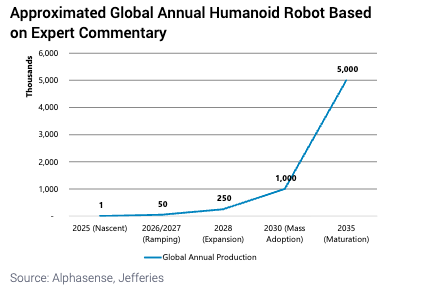
Those deployments are already moving from lab demos toward real factory floors, and some observers warn of military applications down the road. Commercial use will likely accelerate this year and next, then scale more sharply into the end of the decade. Expect a major technological and industrial transition over the next ten years.
Jefferies and other analysts see a clear trajectory: initial ramp this year and next, a steady acceleration through 2030, then a potential quantum leap in the early 2030s. That forecast reflects both engineering progress and shifting labor economics. Companies will weigh these timelines when deciding whether to invest now or wait.
The note pointed to three structural forces driving faster adoption:
- Aging populations, particularly in China and other developed markets, are increasing demand for labor supplementation and assistance.
- Declining interest in manufacturing jobs among younger generations is creating labor mismatches across global supply chains.
- Breakthroughs in semiconductors and AI are sharply improving robot intelligence and functionality while reducing costs.
Labor cost is another disruptive factor. With workers pushing for $20 to $25 per hour and much higher pay for specialized roles, operators could run humanoid machines on a fully loaded basis for roughly $2 to $3 per hour after operating expenses. That delta makes automation hard to ignore for companies focused on competitiveness and margins.
Price trajectory matters too: analysts expect mass adoption to become realistic as unit costs come down toward roughly $25,000 by 2030. When a machine can replace repetitive, low-skilled work at that price, adoption accelerates quickly in logistics, warehousing, and basic assembly. The economic case becomes compelling for businesses aiming to lower costs and improve reliability.
The analysts noted early commercial milestones to watch. “In late ’24, California-based Figure AI achieved a milestone by delivering its Figure 02 humanoid robot to a paying client. Around the same time in China, UBTech Robotics began the world’s first large-scale deployment of full-sized humanoid robots.” Those real deliveries mark the shift from R&D to revenue-generating products.
Melania walking with a humanoid robot this week may be an early policy signal that the administration plans to accelerate American-made humanoid robotics. Clear policy support could unlock a domestic investment cycle across public and private markets, drawing both venture capital and industrial dollars into U.S. companies. That would be a strategic win for innovation, jobs, and national competitiveness.