

Technocracy’s Long Shadow: From Joshua Haldeman to Universal High Income
For those who think technocratic experiments belong only in dusty archives, the genealogy running from 1930s Technocracy to today’s Universal High Income deserves a hard look. The old ideas keep reappearing in new clothes, and they raise the same questions about who decides and who benefits. History matters more than hype.
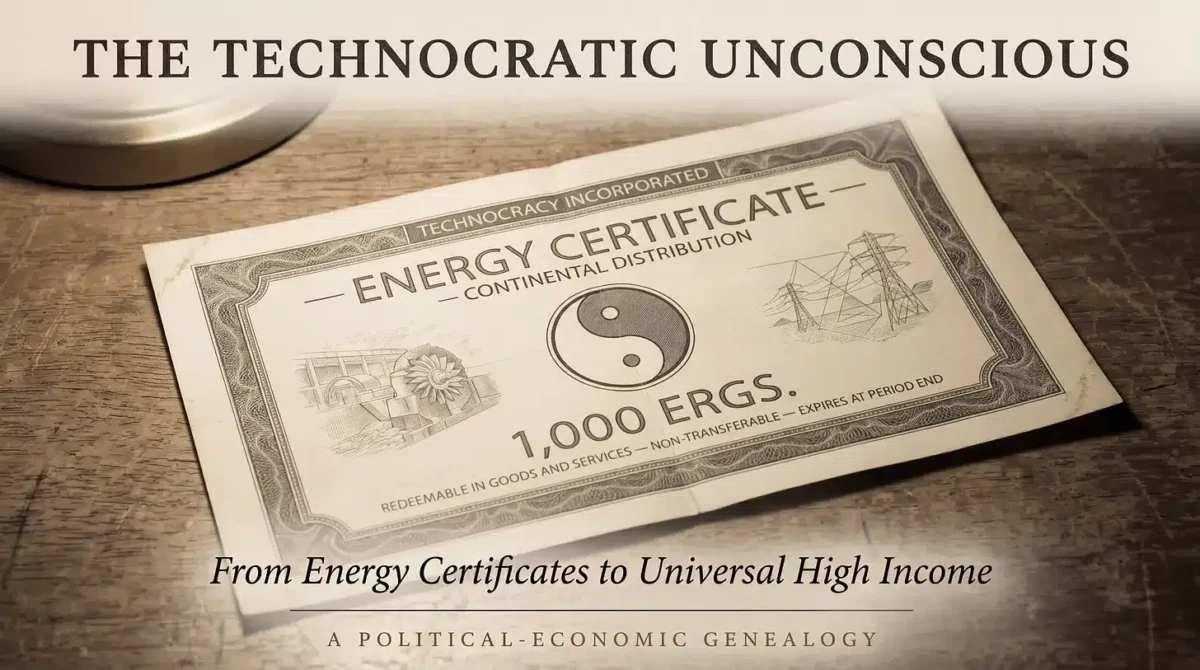
In the 1930s Joshua N. Haldeman helped organize Technocracy Incorporated in Canada, a movement that wanted to replace the price system with energy certificates issued to every person. Those certificates were to be calibrated to continental energy production and administered by an insulated body of engineers, a so-called Technate. The aim was unconditional allotments disconnected from labor and market exchange.
The Canadian branch ran into the state at the outbreak of the Second World War: Ottawa banned Technocracy Inc. under the Defence of Canada Regulations after the group opposed conscription and drew accusations of authoritarianism. Contemporary critics compared its uniforms and stylized salutes to fascist trappings, and later claims linked Haldeman to pro-Nazi sympathies during the war. After that episode he moved toward Social Credit politics, a parallel strand that also argued for dividends and credit redistribution and that faced its own antisemitic controversies.
When a Quebec Social Credit organ printed excerpts of the Protocols of the Elders of Zion in the mid 1940s, Haldeman publicly disavowed antisemitism while simultaneously delivering a speech defending a party newspaper’s publication of the Protocols, arguing that their authenticity was beside the point — the plan as outlined in them, he said, had been ‘rapidly unfolding in the period of observation of this generation’. That rhetorical posture — formal denial at the level of propriety while preserving the operative conspiracy — is the kind of equivocation that keeps resurfacing in elite circles.
Fast forward to the 2020s and the pattern repeats in a new register. Elon Musk’s social-media controversies, including his 2023 endorsement of a “great replacement” post described as “actual truth,” followed advertiser boycotts, an Auschwitz visit, and a public apology calibrated to reputational cost. The sequence looks like a modern version of exposure-and-damage-control rather than a principled reckoning with the ideas themselves.
At the policy level, Musk’s Universal High Income — unconditional transfers tied to AI and automation-driven surplus — shares a clear structural kinship with Technocracy’s energy certificates. Both designs present a universal eligibility and a conditional distribution: the allotment size, adjustment rules, and administrative control are what actually determine outcomes. In a cybernetic system, whoever controls the feedback loops controls the distribution.
That cybernetic framing has deep precedents. Stafford Beer’s Project Cybersyn for Allende in 1971 built a real-time economic nervous system and was explicitly organized around what Beer called the Viable System Model: a sociotechnical organism. Beer’s Operations Room sought continuous engineering adjustment of production data, illustrating how technical governance can be operationalized at national scale.
The story widens when you add Silicon Valley actors. Peter Thiel has argued that founder-led institutions can supplant democratic deliberation, and parts of the tech right embrace variants of neocameralism and networked sovereignty. Those proposals funnel political authority into corporate or networked hands rather than into accountable democratic structures.
Intellectual currents from left-accelerationism through Nick Land’s unconditional accelerationism have fed into this mix, and cyberpunk and cypherpunk ideas about distributed protocols have been grafted onto administrative visions. The result is a hybrid: top-down administrative mechanisms for distributing abundance married to bottom-up technical systems for coordination and exit.
That fusion matters because it gives the technocratic unconscious fresh tools: capital, cryptography, and corporate-legal innovation. When the grandson of a Canadian technocrat proposes federal checks as a response to AI-driven disruption, he isn’t inventing a new problem so much as tapping an old playbook with modern infrastructure. The real question remains the same across generations: who sits at the controls, and what safeguards protect democratic decision-making?